In a famous 1929 essay, Virginia Woolf wrote, “A woman must have money and a room of her own if she is to write fiction.” Woolf was right, of course – any novelist needs peace and quiet in which to work. Harriet Beecher Stowe, who reportedly wrote at a corner of the kitchen table while her seven children cavorted nearby, was an obvious exception, although I find the story as dubious as that of the Chinese peasant woman who interrupts her plowing to give birth in the field and then picks up the reins again.
For painters, the need for a physical space – call it a studio or whatever you will – in which to create art is paramount. Oil paints take time to dry before revisions can be made. A session must be ended for the day when the light changes, and the easel must be left undisturbed. The physical needs of a painter are much more difficult to satisfy than those of a writer.
Traveling through the Berkshires recently, Roberta and I visited a site which reflects the truth of Woolf’s perception. The Frelinghuysen-Morris House and Studio in Lennox was the home of two abstract artists who were dubbed “the Park Avenue Cubists,” George L.K. Morris (1905-1975) and Suzy Frelinghuysen (1911-1988).
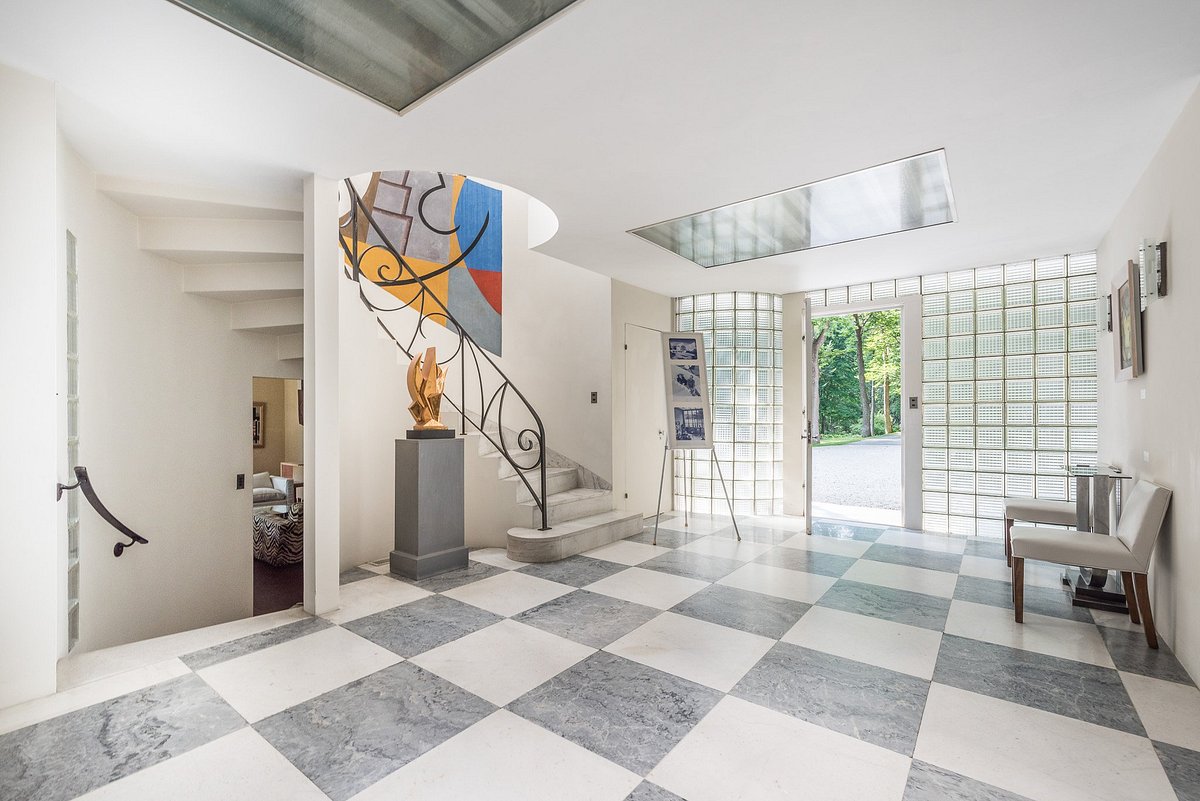
Entrance foyer to Frelinghuysen-Morris House, Lennox, MA
Photo courtesy Frelinghuysen-Morris House and Studio.
Born at the tail end of The Gilded Age, the artists, who married in 1935, grew up in privilege as members of New York and New Jersey families who had produced generations of statesmen and diplomats. After graduating from Yale, Morris rejected his family’s push toward a legal or political career, studying first at the Art Students League and later in Paris, where he became a confirmed abstractionist. In 1936 he was one of the founders of the American Abstract Artists (AAA), a group which sought to broaden the recognition and acceptance of abstract art in this country.
Frelinghuysen attended Miss Fine’s School (of course) in Princeton and was privately tutored in art and music. Encouraged by her new husband, she became an abstract painter and joined the AAA soon after its founding. They spent their summers into a Le Corbusier-inspired house that Morris had built on his family’s summer estate in the Berkshire Mountains, a building to which a large studio wing was soon added. Frelinghuysen had a room of her own indeed. For the rest of their lives, the couple avoided Manhattan’s summer heat while adorning their home’s walls with frescoes in addition to creating easel works. Frelinghuysen, a gifted soprano, took a hiatus for a few years after World War II to sing at the New York City Opera. Tosca was a favorite role.
Despite the AAA’s efforts, American geometrical abstraction has languished in the shadow of its European forerunners, and it does not bring anything today like the prices fetched by the slightly later Abstract Expressionists. Good pieces by Morris and Frelinghuysen from the 1930’s and 1940’s generally bring mid-five figures at auction today, although a large work by Morris brought $163,800 last year. As my readers know, the market for women artists has been hot for the past few years, as institutions seek to remedy years of neglect. There has not been a truly important work by Frelinghuysen since 2018, when a large oil brought $552,500. I suspect a similar work offered at auction today would break that record.
Inherited wealth and the jealousy it may incur can have a detrimental effect upon critical consideration of an artist’s achievement. The “Park Avenue Cubists” moniker, while descriptive, has a hint of a put-down by less-monied contemporaries, and critics who honed their skills in the Trotskyist atmosphere between the world wars were likely to be suspicious of artists who didn’t starve in garrets. Yet Morris’s and Frelinghuysen’s achievements are solid. Whether you’re male or female, money and the room it can get you don’t hurt.
From Lennox, Roberta and I drove up to Williamstown, home to one of the finest museums in the United States, The Clark Art Institute, which has an exhibition even more in keeping with the subject of this blog. A Room of Her Own: Women Artists-Activists in Britain, 1874-1945 is a testament to some first-rate art produced by some very determined painters.
It was difficult to get a professional art education in late Victorian and Edwardian England. Female students had to fight even to get the right to paint nude models. Most well-recognized art schools did not accept female students. The Slade School of Fine Art, founded in London in 1871, was a notable exception, accepting female students from its beginning, and many of the artists in this exhibition got their first professional training there.
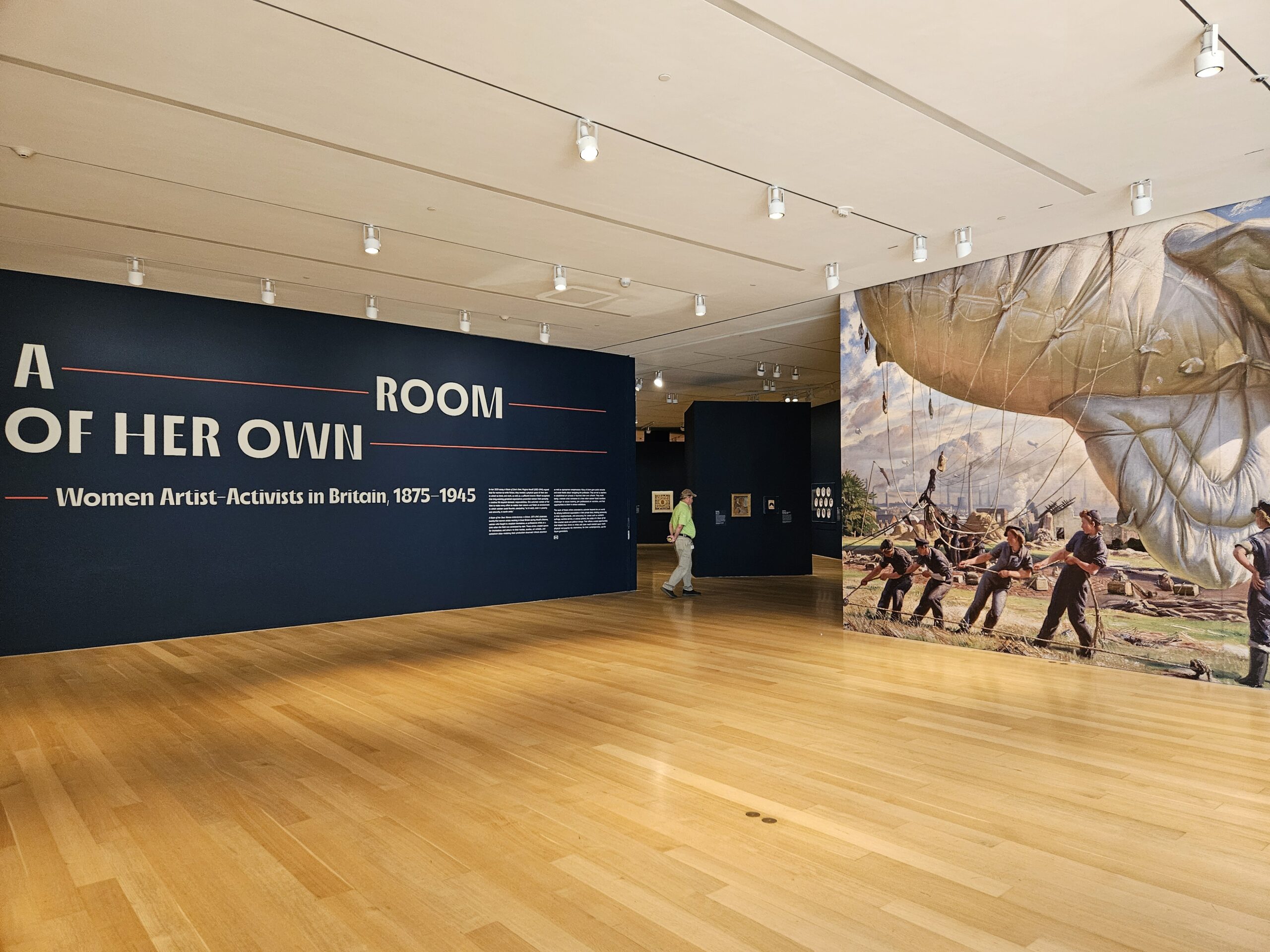
The Clark Art Institute, Williamstown, MA. The painting depicted at the exhibition entrance is an enlarged reproduction of A Balloon Site, Coventry, 1943, by Dame Laura Knight (1877-1970), oil on canvas, 40-3/8 x 50 inches, Collection Imperial War Museum, London.
Some of the artists in this show, such as Anna Alma-Tadema and Mary Morris, were the daughters of well-established male artists. Some, like Vanessa Bell, came from money. Some had husbands who supported them financially. Some supported themselves by cobbling together a living by teaching, lecturing, illustrating, or writing textbooks on painting and printmaking. What each of these women had initially were a middle-class background at least and a family who encouraged her to follow her artistic bent.
If it takes a village to raise a child, perhaps it takes an artistic “village” to encourage a young woman to dream of becoming an artist and to instill in her the character and tenacity to achieve a room of her own.