Who’s the greatest American artist of the late 19th century? I think you have to leave John Singer Sargent out of the running: though he had American citizenship, he was born in Italy, trained in France, and spent most of his life in Europe. Sargent aside, I suspect that most art historians would award the crown to either Thomas Eakins or Winslow Homer. You can make the case either way, but I prefer Homer, and much of the American art public agrees with me, or so it seems based on the crowds for the recent Homer exhibition at the Museum of Fine Arts, Boston.
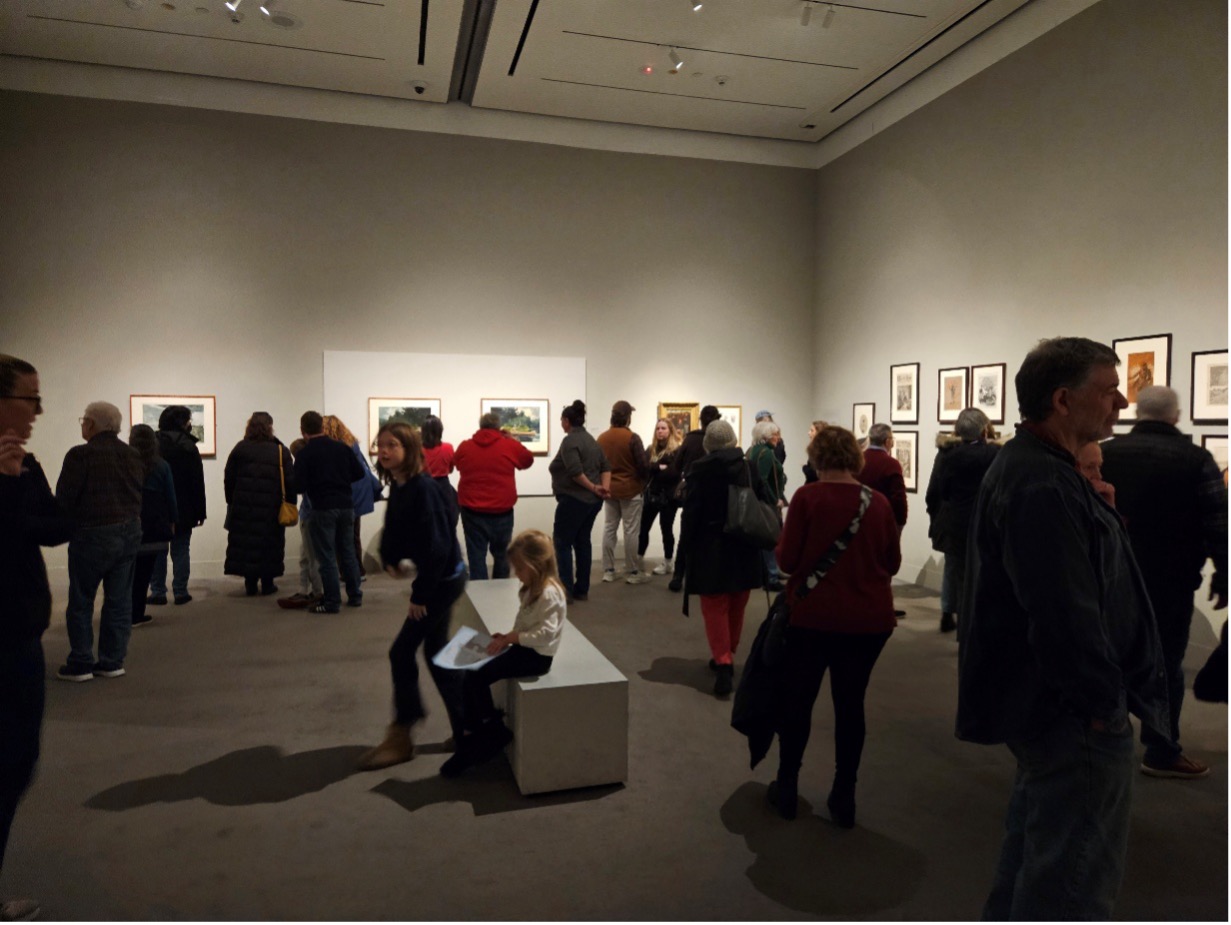
Roberta and I attended the show a week before its closing, and the place was packed. You needed Roller Derby-style elbow armor to see everything, or at least an enormous amount of patience. (Roberta asked a guard when the best time to see the show was if you didn’t want to feel as if you were on the subway at rush hour. “Wednesday afternoon, 4:00 PM to closing,” was his answer.)
It’s not surprising. Generations of schoolchildren grew up seeing reproductions of Snap the Whip, The Herring Net, The Gulf Stream, or half a dozen other Homer paintings in textbooks or as illustrations on the wall of their classrooms. Union soldiers in the Civil War, deer hunters in the Adirondacks, elegant young ladies playing croquet, fishermen earning a cold and brutal living — Homer captured all aspects of American life. There’s a subject in his work to interest almost anyone.
Most of the works in the Boston exhibition were watercolors, many of them drawn from the museum’s own inventory, which to my taste is one of the two best Homer watercolor collections in the country. (The Brooklyn Museum has the other.) Homer was born in Boston, and art-lovers from his hometown early on became some of his most enthusiastic patrons.
Homer was one of those artists – William Trost Richards and Henry Farny are others – who did wonderful oils, but whose true genius is reflected in watercolor. Watercolor has been called the perfect medium for one who knows nothing about art and for one who knows everything, and that’s true. Watercolors are much easier than oils for a beginner to use, yet in the hands of a master like Homer they are capable of a depth and richness that is magical. The Museum of Fine Arts acquired many of its watercolors during Homer’s lifetime or soon after his death, and the care which it has taken in preserving those watercolors means that the works remain today in much the same condition as they were when they left the artist’s studio. Their colors just glow.
I am always of two minds regarding large exhibitions such as these. I threw my elbows and managed to see all the watercolors, but it’s like eating an entire box of bonbons at one sitting. Better to spend real time with a half-dozen of them. You’ll find you’ve had a full, rich meal.
In terms of the art market, Homer definitely ranks above Eakins, though in fairness it must be said that no major Eakins work has been offered at auction in almost a quarter century. Most of what has come up have been portraits, which are not popular with collectors. No one knows what one of Eakins’s Schuylkill boating scenes would bring today, certainly well into eight figures.
In the auctions last week, Homer did fine. The small oil below brought $1,778,000 including premium.
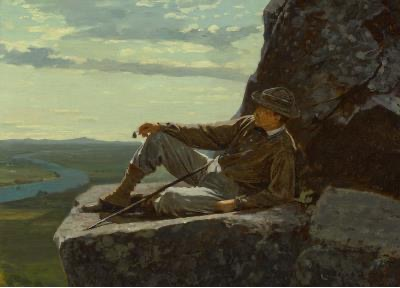
Photo courtesy Christie’s, New York, NY.
The lovely watercolor below brought $825,500, including premium.
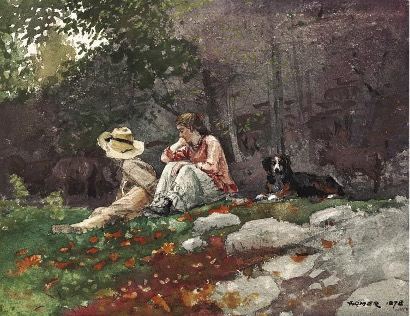
8-3/4 x 11-1/4 inches. Photo courtesy Christie’s, New York, NY.
For those of us who don’t have that kind of dough, we’re lucky that Homer was prolific and that most American museums have at least one example of his work. That’s all you need to fill yourself. Enjoy!