Fine art appraisers typically use what is called the Sales Comparison Approach when calculating a value; that is, the appraiser looks at what similar paintings by the artist have sold for and then derives from those sales a value for the work being appraised, allowing for differences in size, subject matter, condition, and other factors.
But what do you do when the artist being appraised has no auction records?It is a problem I had to solve last year when I was appraising works from the estate of Margo Pelletier (1951-2016). Born in Bangor, ME, Pelletier showed an early interest in art, and her parents encouraged her studies of painting, sculpture, and photography. She attended the Boston Museum School and the Hartford Art School before receiving her BFA from the Cooper Union for Science and Art in 1988.
Pelletier was active in left-wing New York politics and was a co-founder of the artist advocacy group Progressive Culture Works. In the late 1970’s, she worked with the May 19th Communist Organization in Brooklyn, eventually leading their propaganda facility, the Madame Binh Graphics Collective. After an action to protest Apartheid in 1981, Pelletier was arrested and spent six months in the city jail on Rikers Island. Those six months, more than any other experience in her adult life aside from identifying as post-queer, shaped the foundation of her work to come.
In the early 1990’s Pelletier was one of the founding members of the artists’ community at 111 First Street in Jersey City, NJ. By the end of the decade, she had become interested in the medium of sound and began studying the subject at Bard College. It was there she started making dramatic pieces she called sound-scapes.
After a short time of consciously not allowing herself to work in images, Pelletier decided to couple her new work in sound with her experience as a visual artist. This led her into filmmaking. In 2000 with her wife, Lisa Thomas, Pelletier formed the film company Thin Edge Films and directed several award-winning short films, documentaries, and videos.
Pelletier had several one-person exhibitions in the New York area over the course of her career, plus a solo exhibition, “Chain of Incident,” at Kean College in Union, NJ, in 1994, but she never achieved major commercial success, which was probably to be expected, given her subject matter and political stance. None of her works has come up at auction, either during her lifetime or posthumously. Last year, however, several of her works were donated to the New Jersey State Museum. A tax deduction was called for, and I was asked to do the appraisal. How was I to make a convincing case for their value when there were no auction records and only a handful of retail prices from works sold almost 30 years ago?
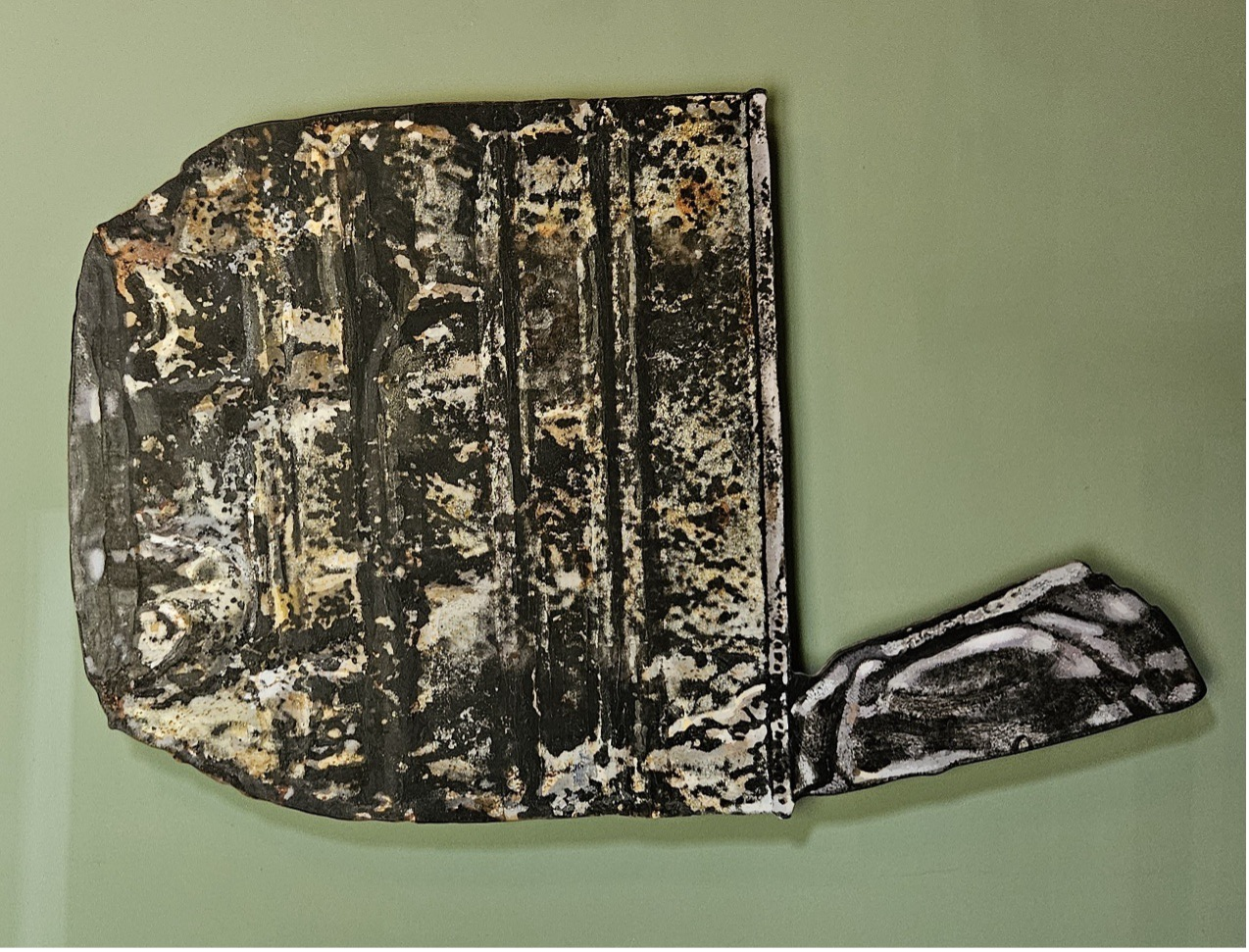
Margo Pelletier, Untitled (Open Can) from the series Chain of Incident, 1993
Acrylic with photo silkscreen mounted on fiberboard, 30 x 47 inches.
Photograph by Reagan Upshaw
Trying to determine a measure of value, I decided to look at Pelletier within the context of her times. The place of women artists in the American gallery scene is problematic today, but 60 years ago things were even grimmer. In 1972, frustrated at women’s lack of inclusion in the commercial gallery scene, 20 women artists co-founded A.I.R. Gallery, one of the first women’s co-operative galleries in the country and currently the longest-running such institution. The art of many of the co-founders of A.I.R. Gallery dealt with feminism, anti-racism, and other political issues. So did Pelletier’s, although she was not a member of the gallery.
I looked for the auction records for all 20 co-founders of A.I.R. Gallery. Eleven of them had no auction records. Three members have gone on to significant commercial success, with works selling in six and even seven-figures; they were thus not appropriate comparisons for Pelletier. I then looked at the remaining A.I.R. artists, many of whom were included in museum and gallery exhibitions and whose works sold at auction for four and lower-five-figure prices. Their sales records would be proper comparisons for Pelletier’s. Taking into account such things as subject matter, size, and medium, I was able to craft a convincing case for the value of individual pieces.
My first boss in the art business told me, “You’ll never really know what a painting is worth until you try to sell it.” But sometimes you don’t have to go that far.